
Grounds
In 1968, New Zealand’s first internationally qualified landscape architect, Harry Turbott, developed a modernist design for Freemans Park’s grounds. While no formal or original planting plans have been discovered, there has been extensive city archive research which has enabled Freemans Park to reconstruct the likely design intent based on Harry’s known principles and stylistic approach.
“Freemans Park was, at the time, a visionary and ambitious model for inner city living in the 1960s, which remains largely unmatched today. It continues to be an important and rare example of integrated mid-century modern landscape design from this period in Aotearoa New Zealand’s urban history.”
Garth Falconer, Director and Founder
Reset Urban Design
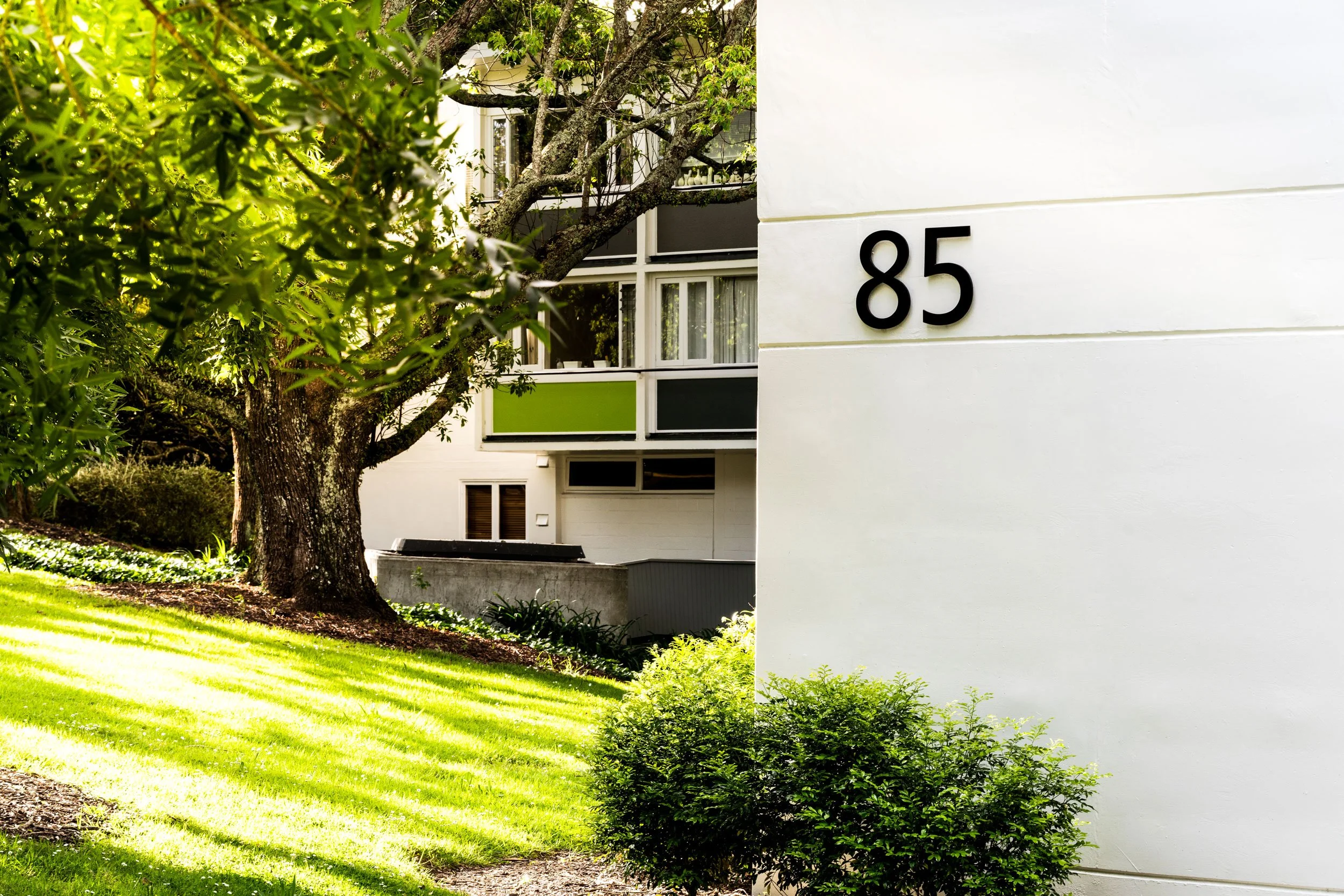
Harry Turbott envisioned a resilient, low-maintenance landscape with a distinctly park-like character. His vision was defined by gently and uncluttered rolling lawns; large-scale canopy trees in open spaces; tree plantings that provided seasonal interest; the use of deciduous trees to allow light in during winter; an internal road’s avenue of cherry blossom trees; minimum street frontage plantings for the star blocks; small curving park beds that were placed to address steep slopes, borders and paths; and planting with a restrained, elegant palette.
The planting favoured soft pastels, with tree species offering pink and blue hues in spring. Autumn showcased red, claret, yellow, and brown, with garden beds designed around shades of blue, white, and silver. Key species likely included oaks, ash, liquid ambers, paulownia, cotoneaster, a variety of prunus such as peach and plum trees, agapanthus, acanthus, and teucrium which all contributed to a cohesive and timeless tree and planting aesthetic.
The aim of this restrained planting approach was to minimise the visual clutter and reduce maintenance costs. Implementation of Harry’s landscape design began in 1968 and was completed by 1971.
His early ideas of fostering a strong sense of community, integrating the development with the broader city fabric, addressing the functional needs of high density living, and managing infrastructure such as car parking and landscape maintenance continue today, and still resonates with contemporary urban design thinking.
Residents began planting their courtyard gardens in the early 1970s, and occasionally strayed beyond their boundaries. As a result, there has been some gradual divergence from Harry’s principles.
That divergence from the Harry Turbott vision is now being addressed, with Freemans Park’s owners deciding to remove the problematic plantings, species, and encroachment. In so doing, Harry’s vision for Freemans Park’s grounds is once again restored.
In early 2025, almost 60 years after Harry completed Freemans Park, the Body Corporate commissioned Garth Falconer at Reset Landscape Architects to develop a masterplan to confirm Harry’s vision, theory, and design. Falconer is one of New Zealand’s leading contemporary experts on Harry Turbott and his landscape design work.
The 2025 masterplan seeks to enhance Freemans Park’s identity, and importantly, to anticipate challenges and guide key design decisions relating to the grounds. It also ensures that Freemans Park aligns with current regulations and environmental requirements.
By engaging Reset Urban Design Ltd to develop Freemans Park’s new grounds masterplan, the Body Corporate has helped to ensure that Harry’s gift to future generations may continue to be enjoyed for another 60 years, and beyond.
Freemans Park’s current gardeners are Bark Ltd, a multi-award-winning company specialising in the management and care of significant gardens and grounds throughout New Zealand in an environmentally sustainable manner. In addition to caring for 8.5 acres at Freemans Park, Bark looks after 25 acres at Government House Wellington, 10 acres at New Zealand’s Parliamentary Buildings, and 12 acres at Ayrlies Garden in Auckland.
Source: Reset Urban Design Ltd, Freemans Park Planting Strategy.