
History
From a place that supplied Māori with kai (food), to its importance as an industrial hub and community of workers, Freemans Park’s history is rich. It became a beacon for urban renewal and community housing, and is now a prized location for inner-city living.
Te Ao Māori
Freemans Park is situated at the foot of two merging gullies which run downhill from Te Rimu Tahi (Ponsonby). The Tuna Mau awa (Trapped Eels Stream) ran through Freemans Park and emptied into the Waitematā Harbour at Waiatarau Bay.
Iwi (Māori tribal groups) used this area extensively for fish-drying and processing. Fish that had been caught in the harbour and in Tuna Mau awa were hung on kōranga (scaffolds) to dry, a common method of preserving kai (food). The site provided a rich resource for early Māori who would spend months here before moving south as the seasons changed.
The headland at the western side of Waiatarau Bay was called Te Tō, and a seasonal fishing pā (fortified village) was used there by Tāmaki Māori. Te Tō was occupied in the 18th century by Waiohua paramount chief Kiwi Tāmaki, during the shark hunting season on the harbour.
Early Auckland
Freemans Bay is one of Auckland’s earliest settled areas, planned in the 1840s by Colonial Surveyor Felton Mathew.
It is likely to have been named after James Stuart Freeman – the Private Secretary to Lieutenant-Governor William Hobson and Acting Colonial Secretary in 1840. Freeman was the scribe who wrote out most of the manuscripts of the Treaty of Waitangi.
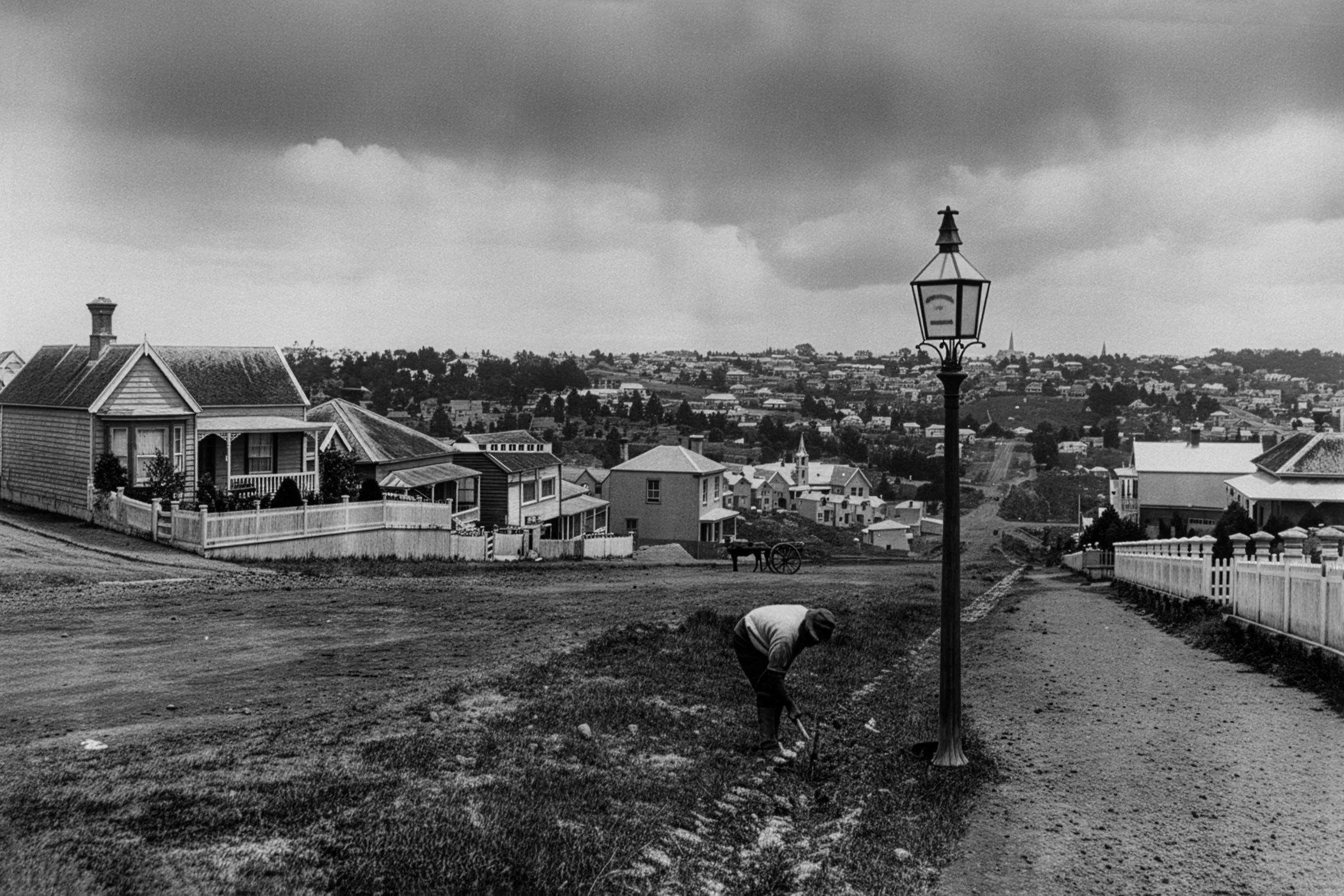
Despite its early development, Freemans Bay was considered undesirable compared to the eastern or “right side” of Queen Street, where Auckland’s wealthy lived. Instead, Freemans Bay became an industrial hub, housing shipyards, sawmills, foundries, gasworks, an abattoir, and waste facilities.
Modest, tightly packed workers’ cottages dominated the area, though larger homes were built nearby on Franklin Road. In 1910 the average house for sale on nearby Franklin Road was advertised for £736, while the average house in Victoria Road, Remuera, was considered worth £1,279 at the time.
As a working-class suburb, Freemans Bay was heavily affected by the Great Depression, with high levels of unskilled labour and poverty. It gained a reputation for crime, prostitution, union activity, and disease. Māori and later Pacific Island migrants settled there for affordable housing. During World War II, the area became known for its brothels and vice activities linked to American troops, and that reputation lingered afterward.
1950s-1970s
In 1951, the Auckland City Council declared a 96 hectare area of Freemans Bay as an area for urban development, and planned to replace the entire housing stock with medium-density housing, destroying the homes of over 7,000 people in the process. While this plan did not come to pass, several developments of flats and townhouses were built in the 1960s, including Freemans Park.
Freemans Bay’s redevelopment in the 1960s and 1970s became a key example of urban renewal in New Zealand. The planning approach, which combined high-density housing with green spaces and a focus on community well-being, was seen as a crucial experiment in shaping New Zealand’s urban future. The project remains a significant milestone in the evolution of urban planning in New Zealand, embodying the shift towards more thoughtful, community-oriented development.
1980s-2000s
Known initially as Philip’s Block, the 201 units at Freemans Park were owned by Auckland City Council and used for social housing.
By the end of the 1990s, Freemans Park’s units were partially privatised by the Council, with many tenants buying their properties. The 51 units retained by Council were eventually sold in 2003 to the government agency, Housing New Zealand.
These two sales processes have resulted in approximately 75% of units now being privately owned, and 25% owned by three institutional social housing investors. It’s a mixed-ownership model that in part reflects the history of Freemans Bay itself.
Today
In recent years, Freemans Park has focused on significantly upgrading long term assets, increasing its maintenance programme, and implementing best practice systems and processes.
The works are delivering major improvements to the building and grounds infrastructure, including everything from electrical assets, to hot water systems, air conditioning and heat pumps, flooring, fences, lighting, gutters and drains, roofing, car parks, way finding signage, and much more. The works are setting up Freemans Park for the next 60 years of its history.
In 2026, Freemans Park is one of Auckland’s most prized inner-city communities.